

In the world of kitchen knives, a duel often takes place between two giants: aesthetically impressive Damascus steel and raw, uncompromising (high-)carbon steel. Many face the choice and wonder: What is the actual difference, and which type is best? The answer requires a deeper understanding that we are not just comparing two materials, but often two different design philosophies.
At Viretta, we work with both principles. This article aims to clear up the confusion, break down the technical differences, and help you understand which type of knife best suits your style and ambitions in the kitchen.
An Important Clarification: Damascus IS Carbon Steel
First, it's important to understand that the question "Damascus steel or carbon steel" is somewhat misleading. At Viretta, our answer is, "Why not both?"
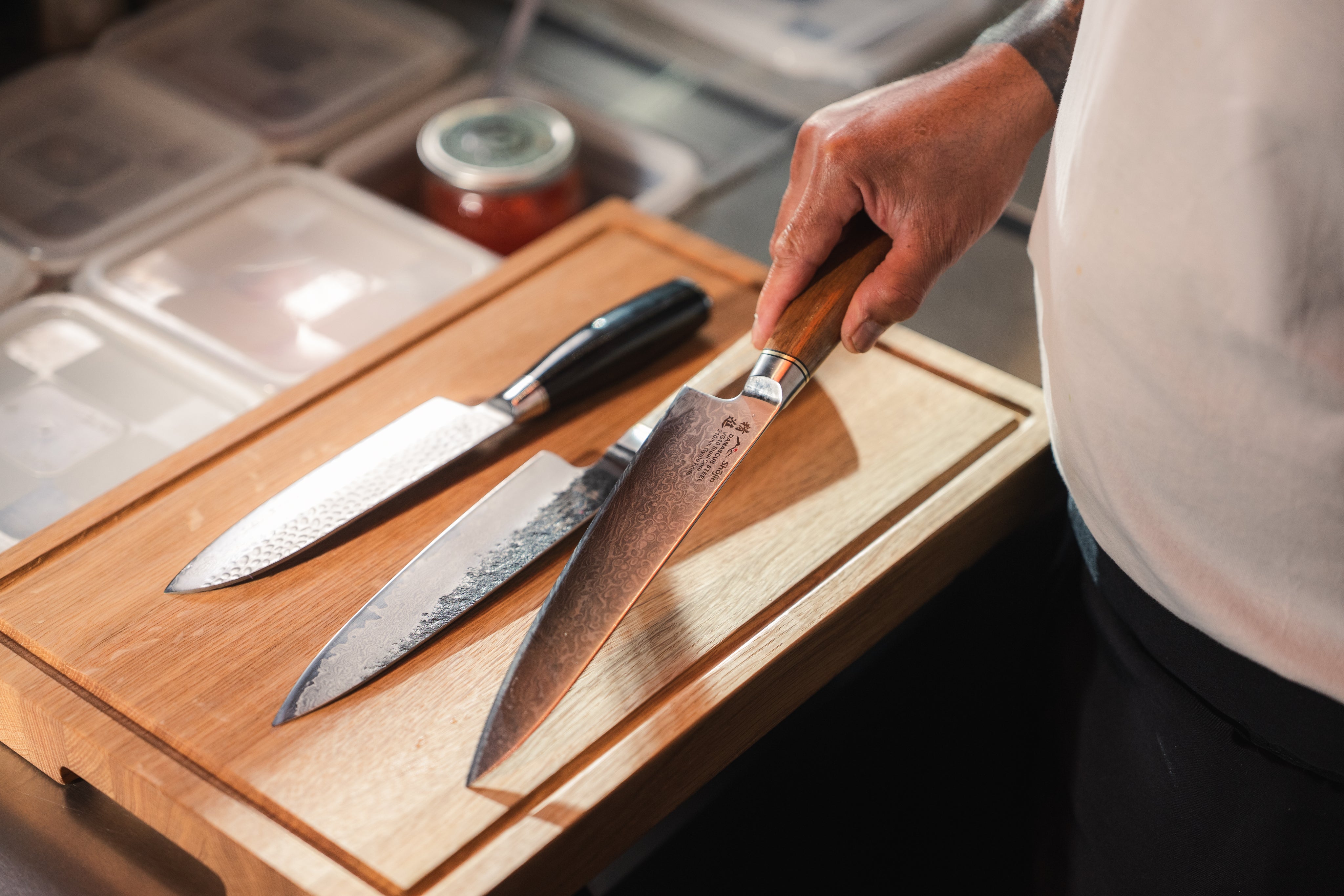
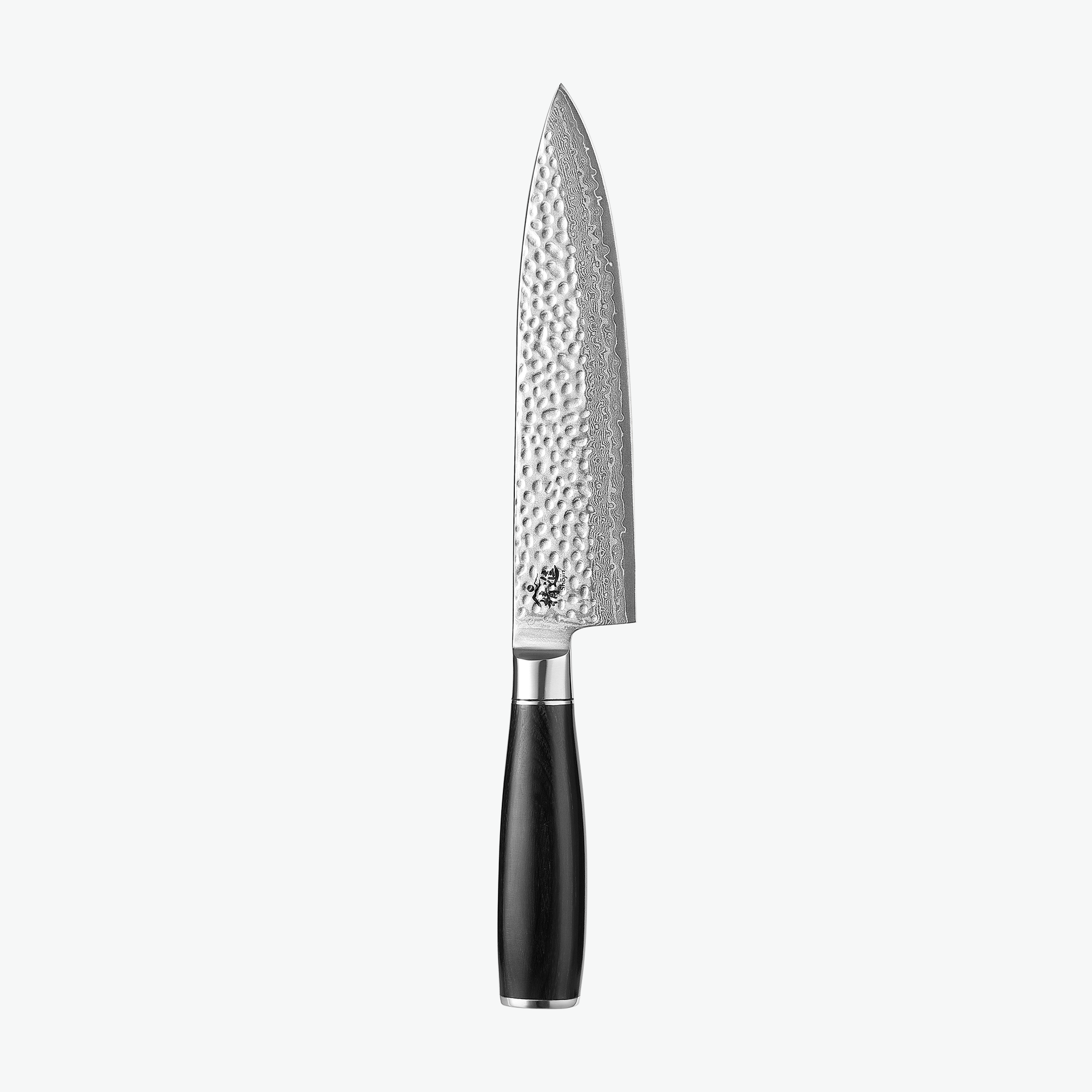
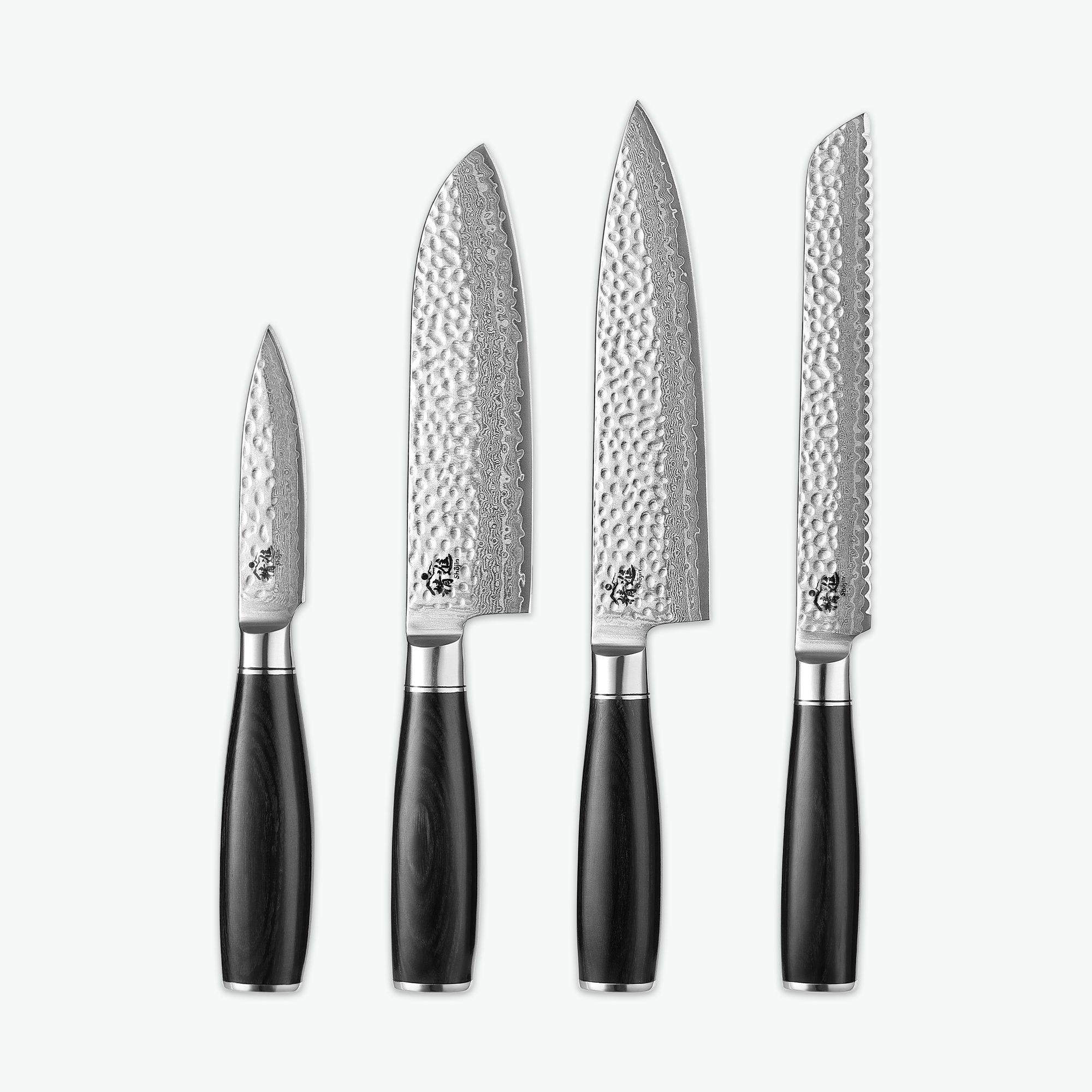
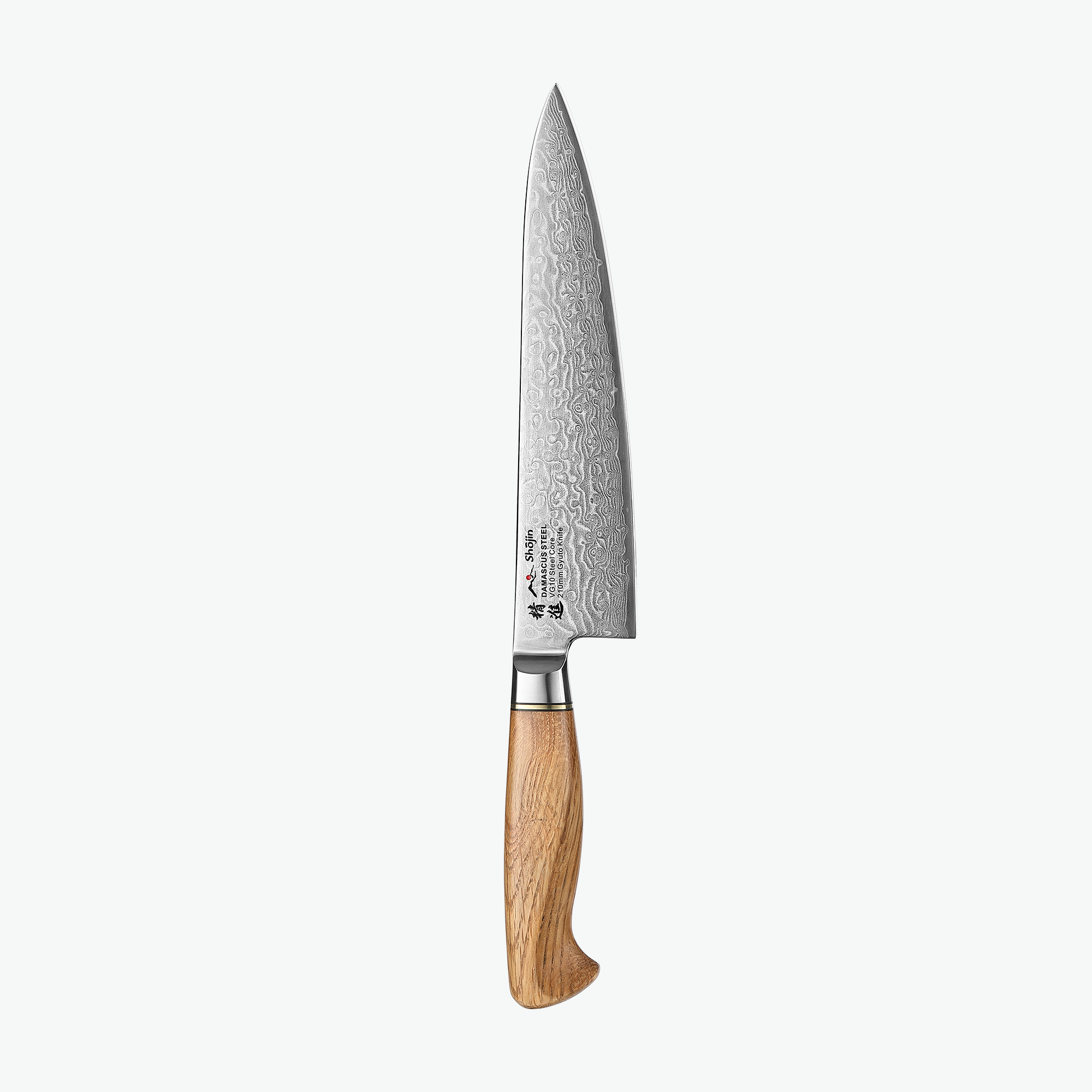
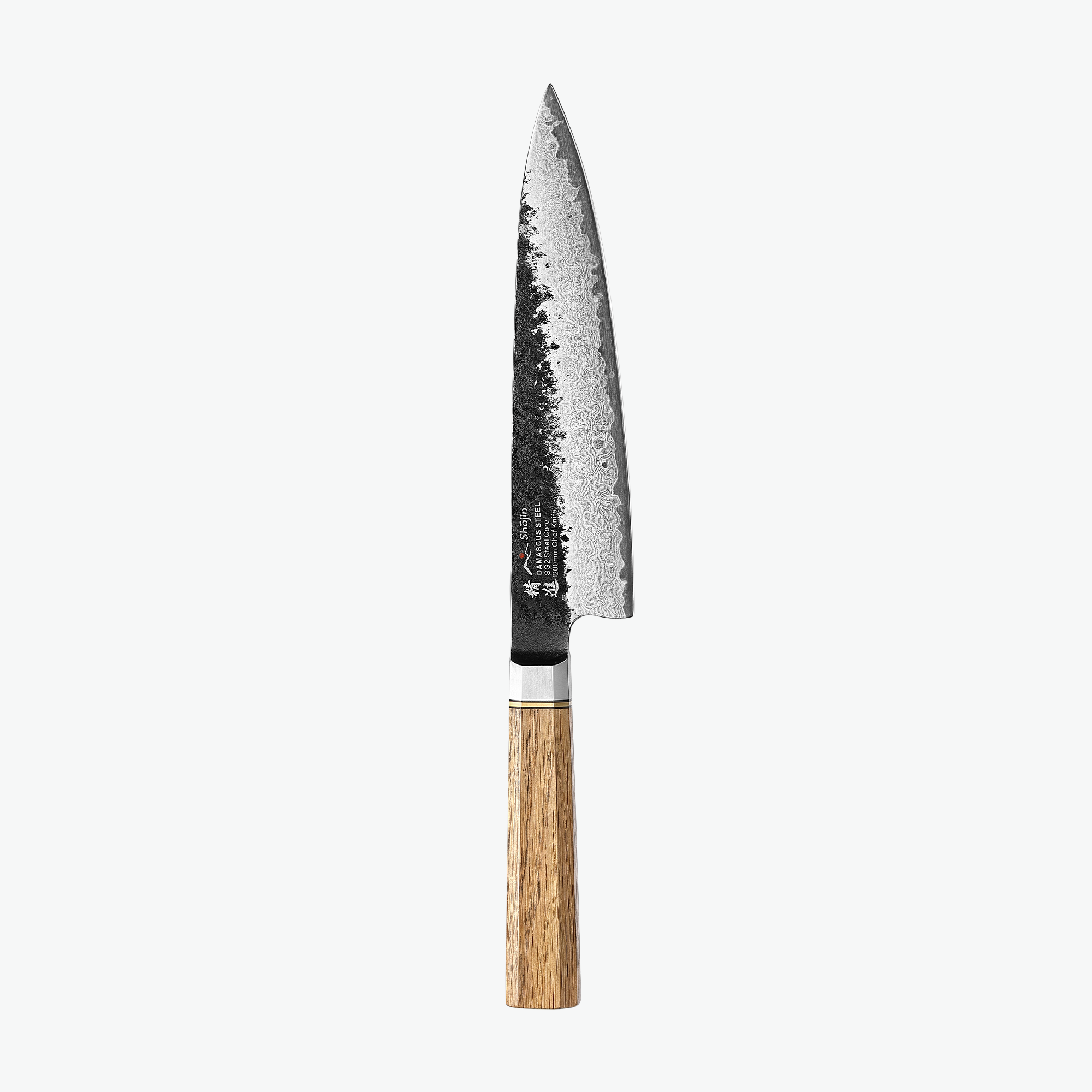
A modern, high-quality Damascus knife is not made from a mysterious, uniform "Damascus material." It is a laminated construction built around a core of high-carbon steel. Our Damascus knives, like those in the Shojin series, have a core of extremely hard, high-carbon steel such as VG-10 or 10Cr15CoMoV. The many outer, folded steel layers serve to protect this core and create the beautiful pattern.
The discussion is therefore not about either/or, but about the difference between a mono-steel blade (a blade forged from a single piece of steel) and a laminated Damascus blade (a blade with a hard core and protective sides).
What is (High-)Carbon Steel?
All steel contains carbon. When the carbon content exceeds about 0.6%, it is called high-carbon steel. Its absolute core competency is its hardness. A high carbon content allows the steel to be hardened to a very high degree (typically 60+ HRC), which results in two things:
- It can be ground to an extremely sharp edge.
- It retains this sharpness for a very long time (excellent edge retention).
The disadvantage is that high hardness often comes with lower toughness (it becomes more brittle) and lower corrosion resistance, as carbon can "absorb" the chromium that would otherwise protect against rust.
Comparison: Monosteel vs. Laminated Damascus
Let's compare a monosteel blade with a laminated Damascus blade in terms of the crucial parameters.
- Hardness and Edge Retention:
The sharpness and the ability to retain it come from the core of the knife. A Damascus knife from our Shojin series (62-64 HRC) therefore has significantly better edge retention than a monosteel knife made from a softer steel like 5Cr15MoV (57 HRC). The edge of a high-quality Damascus knife consists of high-carbon steel in its purest form.
Winner: Tie – it depends on the core steel. A Damascus knife with an elite core will always outperform a lower-quality monosteel knife.
- Toughness and Durability:
Here, the laminated Damascus construction shows its true strength. The extremely hard, but potentially brittle core is protected by many layers of softer and tougher steel. These outer layers act like a shock absorber, absorbing impacts and twists and protecting the fine edge from chipping. A monosteel blade with the same high hardness would be significantly more vulnerable.
Winner: Damascus construction.
- Corrosion Resistance:
Here too, the Damascus construction has an advantage. The high-carbon core can be more susceptible to rust. However, it is protected by the outer layers, which are often made of a more rust-resistant type of steel. Only the outermost, thin edge of the core is fully exposed. This makes a stainless Damascus knife like a Shojin Taru easier to maintain than a traditional Japanese monosteel knife made of pure carbon steel.
Winner: Damascus construction.
- Aesthetics:
There is no competition here. The unique, organic patterns of a Damascus blade are in a class of their own. A monosteel blade may be beautiful in its simplicity, but it cannot match the visual depth and artistic expression of a well-executed Damascus blade.
Winner: Damascus construction.
Summary: Pros and Cons
Damascus Construction
Advantages:
- Combines the best of both worlds: a hard core for sharpness and tough sides for durability.
- Improved toughness and protection against chipping.
- Improved corrosion resistance for the core.
- Unique and beautiful aesthetics.
Disadvantages:
- Significantly higher price due to the complex manufacturing process.
The market is flooded with cheap imitations.
Monosteel Construction
Advantages:
- Simple and honest performance – "what you see is what you get."
Generally more affordable. - Can be extremely robust if a tougher steel (like 5Cr15MoV) is chosen.
Disadvantages:
- Lacks the protective effect of lamination.
- A monosteel blade with very high hardness is very brittle.
Conclusion: Which Construction Suits You?
The choice between a monosteel knife and a Damascus knife depends on your priorities. It's not about good or bad, but about different design philosophies.
- If you opt for a monosteel knife, like one from our Classic series, you choose an uncomplicated and extremely robust workhorse. You get reliable performance in a simple and durable package, ideal for the many tasks of everyday life.
- If you opt for a Damascus knife, like one from our Shojin series, you choose a technically superior construction. You get the absolute top performance of a high-carbon core, reinforced by the additional toughness and protection provided by the laminated sides. And as a bonus, you get a unique piece of functional craftsmanship.
Ultimately, the Damascus construction offers a more comprehensive package of performance and durability, albeit at a higher price. The choice is yours – at Viretta, we have ensured that regardless of your preferred philosophy, you receive a tool of uncompromising quality.
Relevant products
-

Shojin Kaku Gyuto Chef's Knife – Eg
Shojin Kaku Gyuto chef's knife with a 210 mm bl...
Shojin Kaku Gyuto chef's kn...
€130,00 -

Shojin Kaku Gyuto Chef's Knife – Walnut
The Shojin Kaku Gyuto with a 210 mm blade was d...
The Shojin Kaku Gyuto with ...
€130,00 -

Shojin Kashi Chef's Knife – Eg
The Shojin Kashi Chef's Knife, 200 mm, is desig...
The Shojin Kashi Chef's Kni...
€169,00


Relevant Articles

Explore More Recipes
Created for a balanced life
Cooking starts with peace of mind, good ingredients, and tools that feel right in your hands. At Viretta, we combine form and function in a modern Nordic design – created for all those who see the kitchen as a place of togetherness and inspiration.